
This blog introduces the Sellability Filter: a simple question we run before building, marketing, or scaling anything. By shifting every role to think about sellability first, we replaced opinions and vanity metrics with real user behavior. The result wasn’t more work—it was clearer decisions, stronger conversions, and growth that felt predictable instead of chaotic.
Why effort stopped working—and what replaced it
Imagine pouring months of time, creativity, and care into something you know could change lives…
Only to hear silence.
No sales.
No momentum.
No signal that anyone even noticed.
That disconnect is one of the most painful experiences for thoughtful entrepreneurs and operators—not because the work is bad, but because it should be working.
We’ve been there.
And the Truth is, the problem usually isn’t effort, talent, or even strategy.
It’s sellability.
Once we stopped asking, “Is this good?”
and started asking, “Is this buyable?”
everything changed.
The Blind Spot Most Teams Share
Most teams believe they have a marketing problem.
Or a content problem.
Or a product problem.
What they actually have is a sellability problem.
When something doesn’t convert, the default reaction is almost always the same:
- build more
- polish more
- add more
- explain more
It feels productive.
But it’s usually avoidance disguised as effort.
Because the uncomfortable Truth is this:
The user doesn’t pay for effort. They pay for clarity that solves a problem fast.
Once we internalized that, the way we worked—and the way we evaluated work—changed completely.
The Two Roles Every Team Member Must Master
No matter what role someone plays on your team—copywriting, engineering, customer success, operations, video, design—there are always two jobs happening at once:
- Their craft
(writing, building, supporting, editing, designing) - Selling Their craft
(making that work immediately understandable, desirable, and buyable to the user)
This is about turning everyone into a salesperson,
just not in the traditional sense.
It’s about recognizing that every function either increases or decreases the likelihood of a “yes.”
If the user doesn’t see the value clearly enough to act, the work fails.
Most teams over-invest in craft and under-invest in sellability.
They assume quality will speak for itself.
In reality, quality without clarity rarely gets heard.
Why the User, Not the Team, Decides What Works
One of the most liberating (and humbling) shifts we made was letting go of internal opinion as the arbiter of success.
Instead of asking:
- “Do we like this?”
- “Does this feel on-brand?”
- “Is this smart enough?”
We started asking:
- “What did the user do?”
Because behavior doesn’t lie. Our minds do.
A thumbnail works when people click it.
A page works when people take the next step.
An email works when people open, engage, and respond.
This doesn’t cheapen the work.
It sharpens it.
When feedback comes from real behavior instead of internal debate, decisions get cleaner—and faster.
Vanity Metrics vs. Sanity Metrics
This is where most businesses get misled.
Vanity metrics feel good.
They look impressive.
They create motion but at a high cost, without traction.
Sanity metrics, on the other hand, tell you whether your work is actually sellable:
- A thumbnail isn’t “good” because we like it…it’s good when our click-through rate is not less than 5%
- A landing page isn’t “good” because it looks clean…it’s good when our lead-to-customer conversion rate is 2%-5% or higher on cold traffic.
- An email isn’t “good” because the subject reads well…it’s good when 40–50% or higher open it.
Vanity metrics answer: “Did this get seen?”
Sanity metrics answer: “Did this move someone to act?”
If a metric doesn’t change behavior, it’s informational—not operational.
How We Decide What’s Worth Scaling
Once we aligned around sellability, we needed a way to make selling possible at scale — without forcing it.
That’s where the Execution Loop comes in.
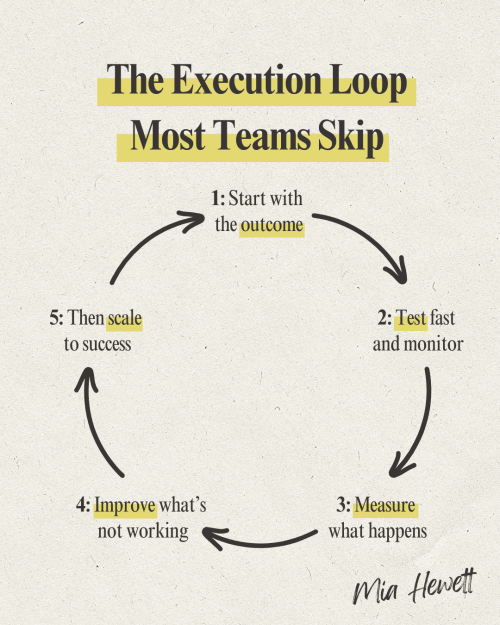
- Start with a specific outcome
- Test quickly
- Measure real behavior
- Improve what’s not working
- Scale only what proves itself
Without this loop, teams default to the most expensive habit in business:
building in private.
Most teams follow a very different pattern:
Build → perfect → launch → hope → panic → rebuild
The Execution Loop replaces hope with feedback.
It doesn’t remove creativity—it grounds it.
What This Looks Like in Practice (Across the Business)
Sellability shows up differently depending on the function, but the question is always the same:
Is this making it easier for the user to say yes?
- Sales: conversations → commitments → cash in the bank
- Content: hook → click → completion → conversion
- Email: opens → click-to-open → replies → revenue
- Customer success: satisfaction → repeat purchases + raving referrals
Different roles.
Same responsibility.
The Psychological Shift That Changes Everything
At a deeper level, this is an identity shift.
Most people unconsciously believe:
“If I give more value, eventually it will pay off.”
Sellability changes this to:
“If I make the value obvious, it will compound.”
This removes the lie about selling.
You’re no longer convincing.
You’re clarifying.
You’re not pushing people forward.
You’re removing friction so they can move themselves.
Sellability FAQs
Does focusing on sellability make the work shallow or manipulative?
No. Sellability is about precision, not pressure. Clear value creates trust. Confusion destroys it.
What if I don’t have much data yet?
Then your job is to get just enough exposure to real users to learn. Small tests beat perfect plans.
I’m not a salesperson—can I still apply for this?
Yes. Selling here means translating value into the copy side to achieve an action, not persuading people against their will.
What’s the biggest mistake people make when trying to be more sellable?
Overcomplicating the message. If someone has to think too hard to understand the value, they won’t act.
And forgetting the importance of coming up with a unique selling proposition that positions themselves as unique, useful, and conceptually simple.
The Bottom Line
Making the Sellability Shift changed everything for us.
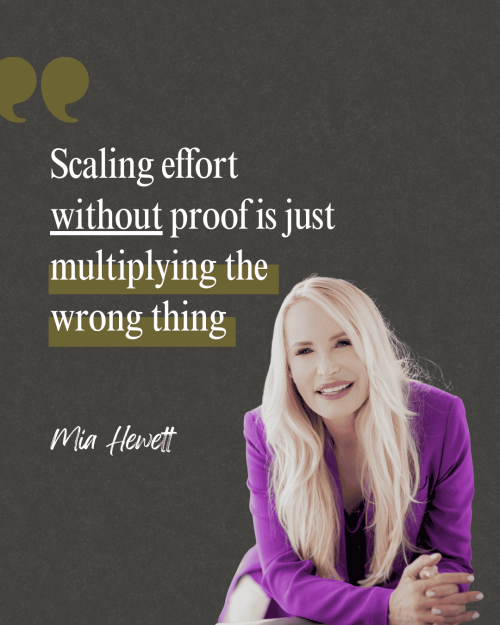
Not because we worked harder—but because we worked differently by stopping scaling with unproven effort.
It led to:
- faster decision-making
- cleaner execution
- stronger conversions
- less burnout across the team
And most importantly, it Aligned everyone around the same question:
Is this actually sellable to the user?
That question is the Sellability Filter.
It tells you what deserves to exist.
But asking the question alone isn’t enough.
The Execution Loop is what turns that question into results.
It’s the system that makes selling possible — without pressure.
The Filter gives clarity.
The Loop creates proof.
Together, they replace guessing with movement.
So if you take nothing else from this blog, take this:
Pick one project you’re working on right now
and run it through the Sellability Filter.
Not in theory.
Not eventually.
Right now.
If the answer is unclear, that’s not a failure—it’s information.
And information is feedback for you to drill down deeper to where better results begin.